
Oak Park Directory Runs
The Oak Park River Forest Museum describes its main Oak Park and River Forest city directory run as 1886 through 1930, with gaps because a volume did not appear every year. The books give names and addresses, and some add relatives, occupations, or a reverse section arranged by street. A Newberry Library finding guide confirms selected Oak Park runs, while a local survey bibliography identifies Delos Hull volumes and later examples. Ask the repository to confirm a year before making a trip. A bibliography entry proves that a title was identified, not that a readable copy is always on the shelf.
| Collection | Years | Where Held | Access |
|---|---|---|---|
| Oak Park and River Forest directories | 1886-1930, gaps | OPRF Museum | Appointment; some reverse sections |
| Selected Oak Park runs | 1890-99; selected 1901-25 | Newberry Library guide | Confirm call number and access |
| Telephone books | 1912-present, gaps | OPRF Museum | Ask for year and regional scope |
| Social registers | 1883-1916; 1932 | OPRF Museum | Partial social context |
The Newberry guide lists 1890-99, 1901, 1903, 1906, 1908, 1910-11, 1915-16, 1919-20, 1923, and 1925. A separate bibliography lists Delos Hull examples through 1968, but those later dates do not form an unbroken collection. Some titles include River Forest, Forest Park, or Harlem. Record the full title and publisher rather than shortening every source to Oak Park.
See Oak Park's 1892 Directory
The Museum publishes a page from the 1892 Oak Park directory, but the web page does not provide a reliable line-by-line transcript. Use the image to study the type, columns, and layout, then inspect the volume's key before quoting any faint entry.
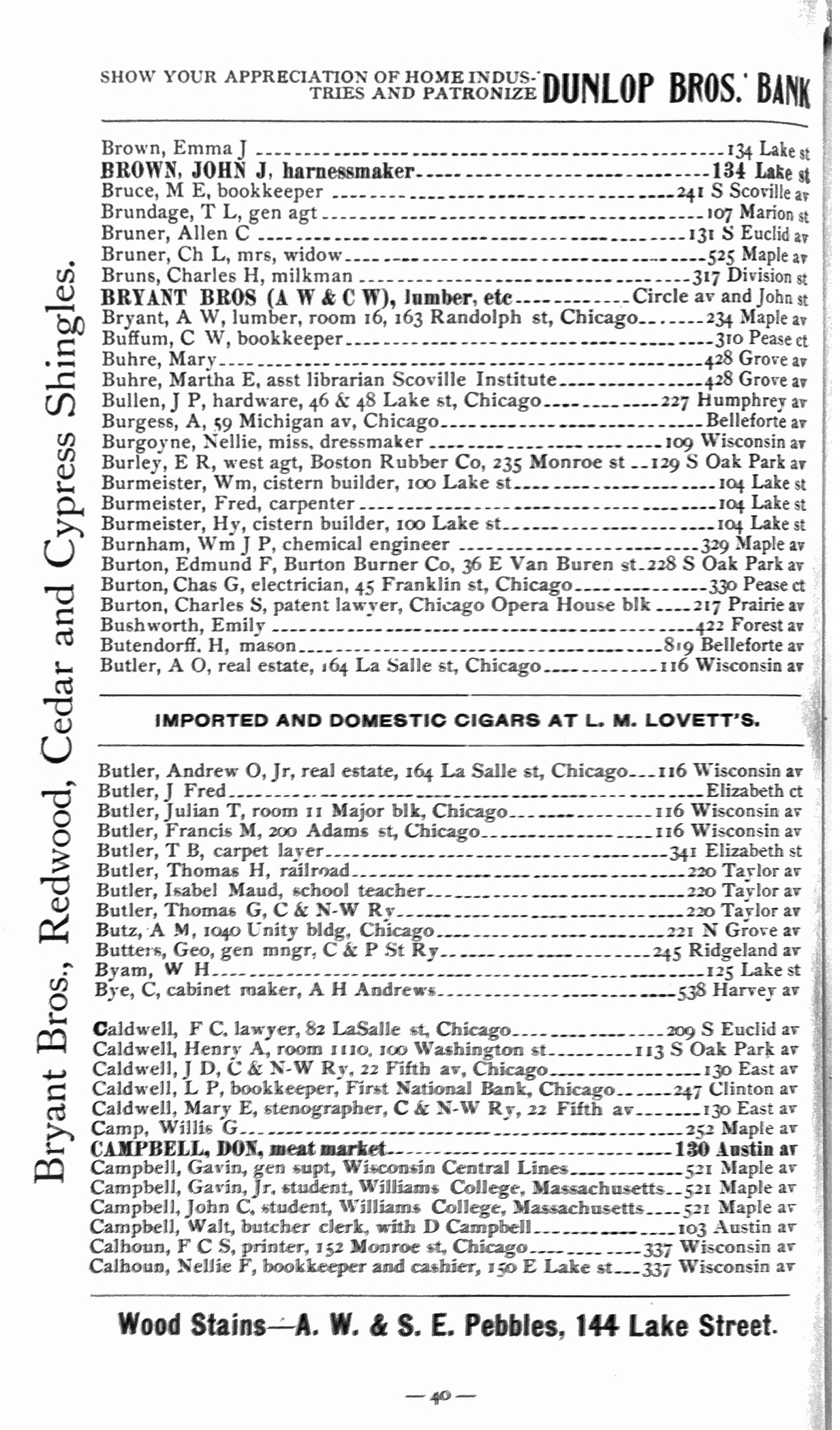
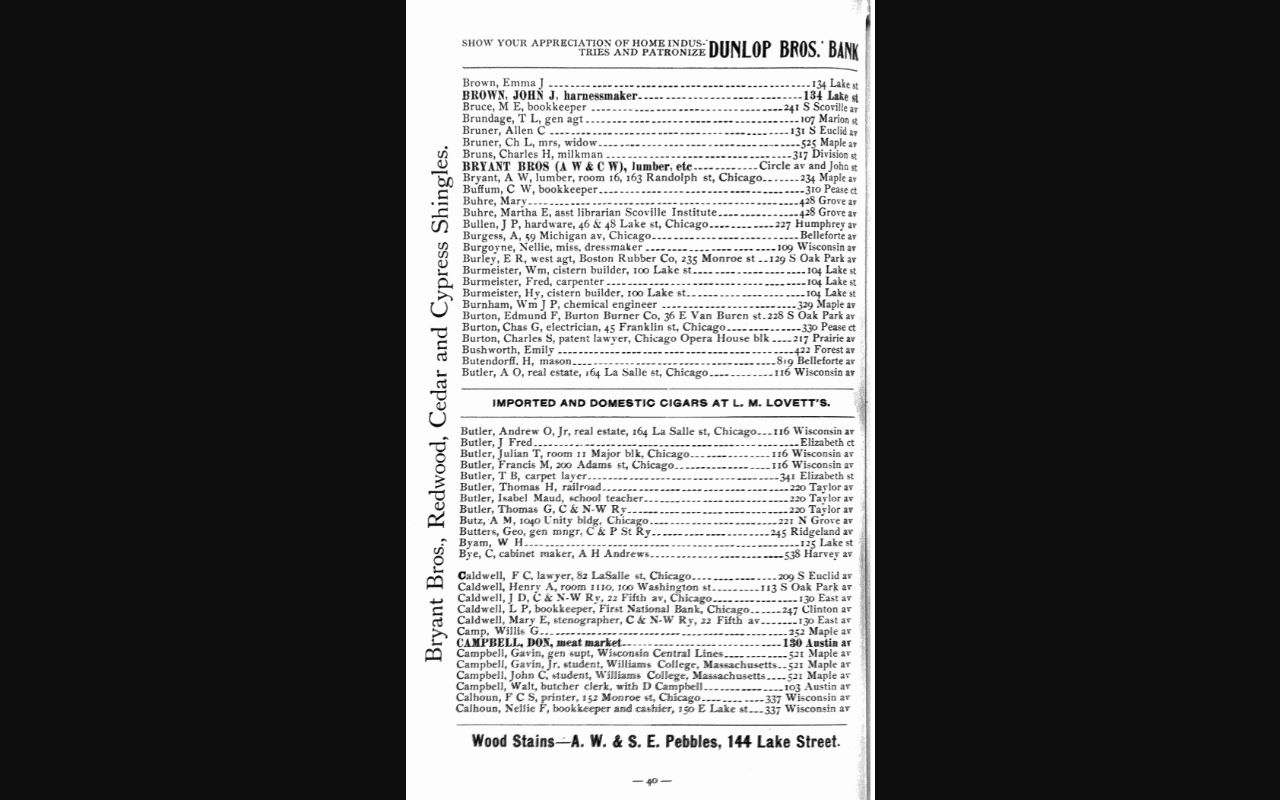
The image proves the volume exists. It does not support guessing at a person's name. A useful citation includes the city directory title, year, page, column, repository, and exact printed form.
Oak Park Historical Directory Shelf
The Museum family-history collection surrounds the city directories with census microfilm, telephone books, biographies, obituaries, yearbooks, photographs, and civic records. Its Research Center at 129 Lake Street is appointment-oriented, and holdings are partial. Send the surname, spelling variants, address, and target years before visiting.
This local shelf helps when a directory entry vanishes. The person may have moved, died, used an initial, been omitted, or appeared under a nearby community. Census schedules cover Oak Park and River Forest from 1850 through 1930 on Museum microfilm. Enumeration-district maps narrow the search to a street, while a newspaper or obituary can explain a gap between two printed volumes.
Note: A missing directory year is a publication gap, not proof that a resident left Oak Park.
Read an Oak Park Entry
An Oak Park city directory entry can identify a person, address, occupation, business, or household clue, but the content changes by edition. Begin with the surname index. Try initials, married and maiden names, and spelling variants. Copy the line as printed, since a short mark may change its meaning. Publication lag matters too: an address may reflect information gathered months before the book appeared.
| Printed name | Surname, given name, or initials exactly as typeset |
|---|---|
| Address | House number and street in that year's wording |
| Work or business | Occupation or firm when the edition includes it |
| Family notation | Relative or household detail in some volumes |
| Source detail | Year, title, page, column, and repository |
- Criss-cross directory
- An address-first section used to find the listed name at a street number. Only some local volumes have one.
- Householder index
- A list centered on the principal listed person, not a census of everyone at the address.
- Abbreviation key
- The volume's guide to shortened words and marks. Check it before expanding a notation.
Do not infer property ownership from a listed address. A directory supports presence near its publication date. A deed and parcel record answer different questions and should remain separate evidence.
Oak Park Library History Tools
The Oak Park Public Library local-history page links the Steiner Index, which records houses and buildings with original owners, architects, construction dates, and addresses. It also points to oral histories and research partners. The Main Library is at 834 Lake Street. Posted hours are 9 a.m. to 9 p.m. Monday through Thursday, 9 a.m. to 6 p.m. Friday, 9 a.m. to 5 p.m. Saturday, and noon to 5 p.m. Sunday.
The library is an index and access stop, not a substitute for the Museum's directory shelf. Use a Steiner result to connect a printed address with a building date or architect, then ask for its source. The oral-history collection adds community memory, but it is not an official resident roll.
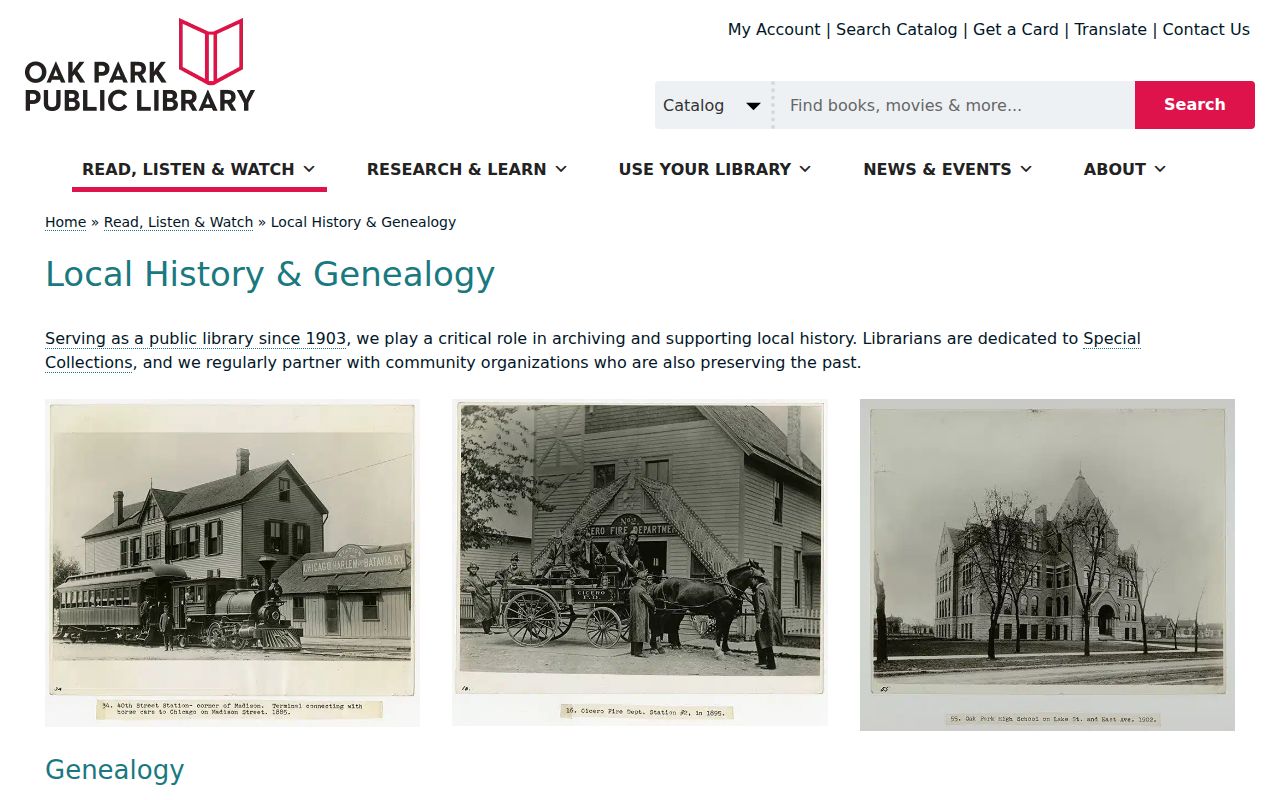
The source page shows these local routes. Review the library's local-history collection before selecting a partner repository.
Oak Park City Directory Gaps
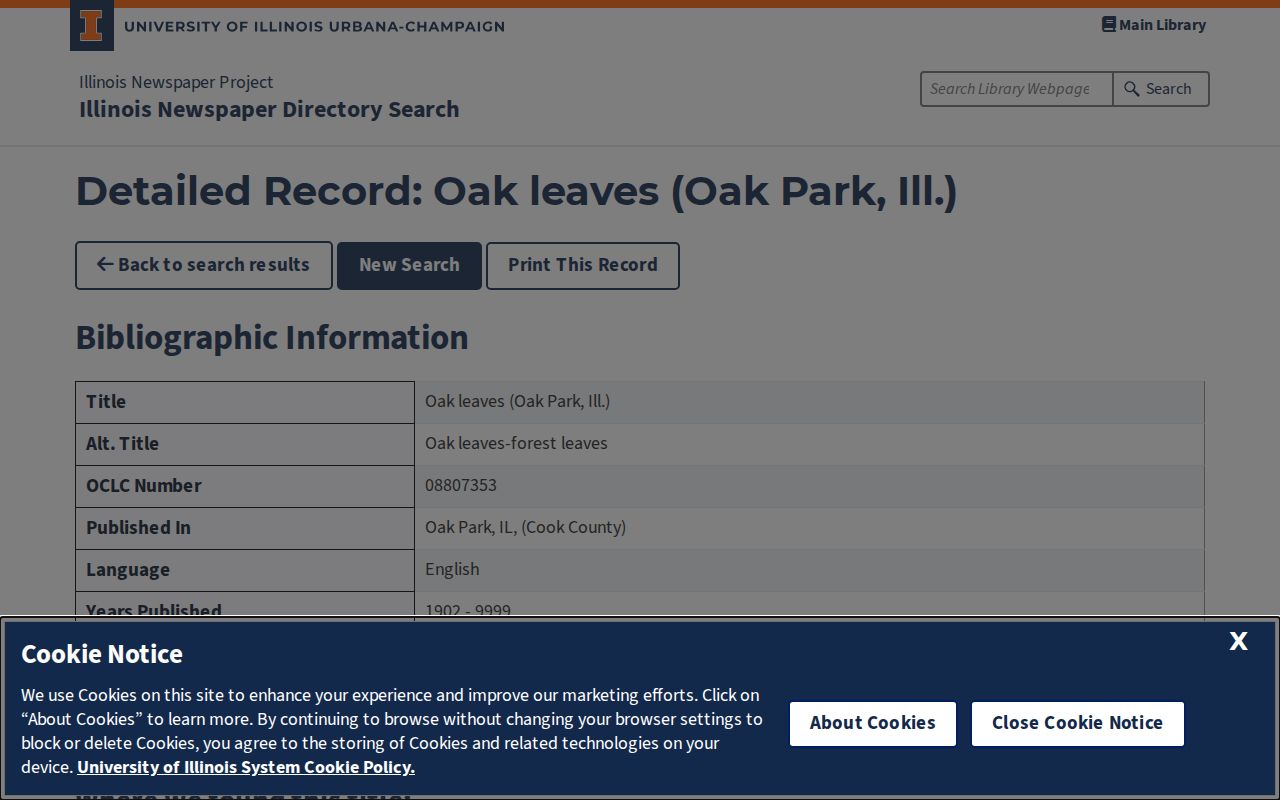
Oak Leaves is a strong companion source. The Illinois Newspaper Project holdings record identifies a possibly incomplete River Forest digital run, Oak Park Public Library microfilm, Museum print holdings with gaps, and a longer microfilm run at the Abraham Lincoln Presidential Library. Search surname, address, street, club, school, and business, then cite the issue and page.
The Museum also has scattered runs of Forest Leaves, Oak Park Reporter, Vindicator, Oak Park Argus, and Oak Parker. An obituary, sale notice, school item, or club report can distinguish two people with the same name. Missing issues still require another repository check.
Oak Park Address Collections
The Museum adds Sanborn maps for 1895, 1908, 1930, 1948, 1951, and 1968. These sheets show building footprint, materials, and street context. Street files cover most Oak Park and River Forest streets, and the Philander Barclay collection has more than 1,000 early images. The Siler Index spans more than a century of newspaper and real-estate references.
W.R. James and Cusack Realty files, dating roughly from 1935 to 1995, may include listing sheets, photographs, descriptions, asking prices, taxes, and an owner name. Those details give context, not a title ruling. Pair them with a directory citation and dated map. Oak Park's architecture records make that contrast useful because one house may appear in the Steiner Index, a Sanborn sheet, a photograph, and a city directory for different reasons.
Cicero Labels in Oak Park Directories
Oak Park was part of Cicero Township before incorporation in 1902. A resident or address from the earlier period may appear under Cicero Township, Cook County, Harlem, River Forest, or a broad directory title. The Museum preserves printed Town of Cicero material and early maps that bridge those labels.
| Before 1902 | Try Cicero Township, Cook County, subdivision, and regional title terms. |
|---|---|
| After incorporation | Search Oak Park, but retain River Forest or Forest Park scope printed on the title page. |
| Unmatched address | Compare directory maps, Sanborn sheets, street files, and legal parcel descriptions. |
A modern place name can be right for today's map and wrong for an old index. That is a geography issue, not proof that the record never existed.
Trace Family Through Oak Park
City directories work best as a dated sequence. They can show address continuity between census years, while the federal census adds household relationships at enumeration time. The Museum holds 1850 through 1930 census microfilm and enumeration-district maps. The 1890 Illinois schedules are unavailable because of the national destruction, so nearby directories and newspapers matter more for that interval.
- Find the earliest likely surname hit, then test initials, maiden names, and alternate spellings.
- Copy the full entry and follow the name through nearby years, noting each address change.
- Use a reverse section, when present, to test who else was listed at that address.
- Compare the directory date with the closest census schedule and enumeration district.
- Close gaps with newspapers, yearbooks, obituaries, cemetery microfilm, and building files.
Oak Park has a useful cemetery quirk: the Museum says no cemetery lies within Oak Park or River Forest. Its Forest Home microfilm covers 1877 through 1980, and German Waldheim material covers 1873 through 1967. Both are chronological, so an estimated date helps. A name disappearing from a city directory may mean a move, death, omission, or change in listing style. Only a second source can tell which.