
Oak Park Address History Sources
The strongest previous-residents search uses sources from several eras. Current county tools identify the parcel and recent title trail. Local collections reach further back and can name actual occupants, but they contain publication gaps. Choose the first source by the period being researched, then cross-check the result in a record of another type.
| Source | Years It Covers | Where Held | What It Shows |
|---|---|---|---|
| Clerk's Recordings System | Current index through Aug. 6, 2026; oldest web year unverified | Cook County Clerk online and office | Deeds, liens, plats, names, PIN, legal description |
| Assessor open data | Tax-year rows back to 1999 | Cook County Assessor Data Portal | Situs and mailing addresses, values, appeals |
| Oak Park and River Forest directories | 1886-1930 with gaps; selected later years | OPRF Museum and selected Newberry runs | Names, addresses, some reverse listings |
| Telephone books | 1912-present with gaps | OPRF Museum | Phone, address, household or business clue |
| Federal census | Museum microfilm 1850-1930; later public releases follow federal rule | OPRF Museum and federal repositories | Household composition at enumeration |
| Sanborn maps | 1895, 1908, 1930, 1948, 1951, 1968 | OPRF Museum | Building footprint, materials, and change |
| House and street files | Varied; realty files circa 1935-1995 | OPRF Museum by appointment | Photos, listings, articles, permits, sales |
For a recent transfer, begin with the Assessor and Clerk. For a household from the printed-directory era, begin with the address section, then compare the closest census and newspaper issue. A building question may start with Sanborn maps or permits even when no resident name is yet known.
Anchor Oak Park Previous Residents
Enter the current address in the Cook County Assessor search and CookViewer. Capture the situs address, every PIN, township, municipality, parcel shape, building traits, and legal description. A PIN is the county parcel identifier. A condominium building or a property assembled from several parcels may produce more than one.
Compare the physical address with the tax-bill mailing address. They can differ because correspondence goes to another place, a trust, an office, or an older contact. Assessor open-data rows go back to 1999 and should always be read with their tax year. A mailing field is a useful lead, but it does not prove that a person occupied the house.
The Cook County parcel open-data source preserves the dated address and value fields needed for that comparison.
Reverse the Cook County Deed Chain
The Cook County Clerk's Recordings System links a current parcel to deeds, mortgages, liens, plats, trusts, and related filings. The index itself is free, while images and document products can carry charges. The portal says an address is informational, so use the PIN, legal description, document number, and grantor or grantee names to keep the chain tied to the same land.
- Copy all PINs and the legal description from the parcel sources.
- Search each PIN in CRS and sort by date and document type. Identify the latest deed, not merely the latest mortgage.
- Record the document number, dates, type, grantor, grantee, associated document, PIN, and description.
- Search the seller as a prior grantee, constrained by the same parcel keys and a sensible date range.
- Follow trust, estate, spouse, corrective-deed, or associated-document links when the ownership path branches.
- Ask Clerk staff for tract or deed-book help when the web index stops. Its oldest online year was not verified.
- Grantor and grantee
- The grantor transfers an interest; the grantee receives it.
- Chain of title
- The linked sequence of recorded transfers for the same parcel.
- Legal description
- The formal land description using subdivision, block, lot, or survey terms. It is more stable than street wording.
A deed chain establishes title transfers, not the full group of people who lived at the property. Match each transfer with a dated household source.
Oak Park House Files Add People
The Oak Park River Forest Museum house-history collection is unusually strong for one-address research. Street files cover most local streets. The Siler Index spans more than a century of newspaper and real-estate references, including permits, sales, and transfers. W.R. James and Cusack Realty files, dating roughly from 1935 to 1995, can add listing sheets, photos, descriptions, asking prices, taxes, and an owner name.
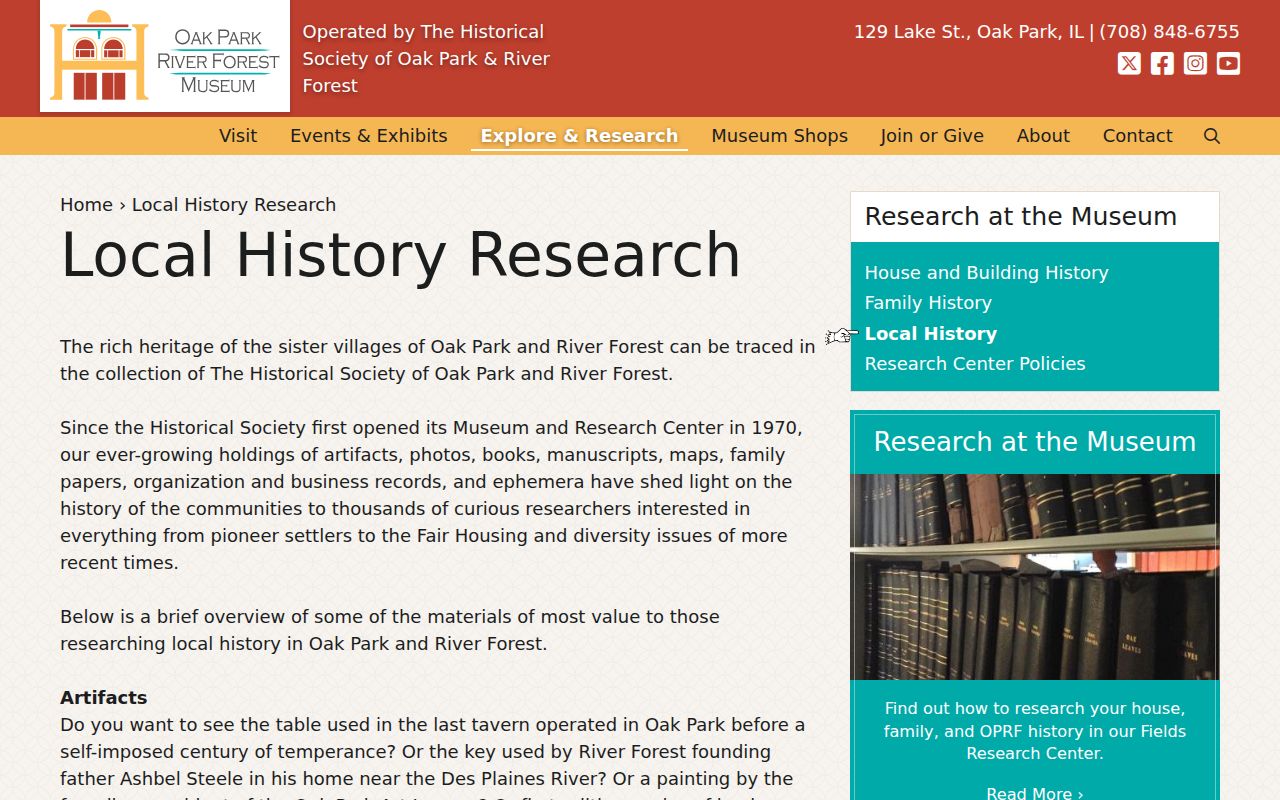
The source page can be previewed through the project capture below.
A research appointment should name the exact address, spelling variants, rough years, and the type of item sought. Holdings are partial, so an index hit should lead to the original file, image, page, or volume.
Date an Oak Park Building
A resident trail can break because the structure changed, not because the person vanished. Compare Oak Park Sanborn sheets from 1895, 1908, 1930, 1948, 1951, and 1968. They can show footprint, porch, garage, materials, or a shift in use. A map does not identify an occupant, but it helps determine whether two address records refer to the same building.
Village permits and Assessor property details add work dates, plans, inspections, building traits, divisions, and consolidations where retained. The Museum's old-house research guide recommends starting with what is visible, checking building records, then moving through street files, photos, maps, directories, and deeds.

The captured guide reinforces that house history is a chain of unlike sources, not a single resident list.
Search Oak Park Before 1902
Oak Park belonged to Cicero Township before Village incorporation in 1902. Previous residents from that period may be indexed under Cicero Township, Cook County, a subdivision, or a directory title that also names River Forest, Harlem, or Forest Park. Search each historically valid label instead of forcing the modern city name onto every source.
No official source in the research established one complete Oak Park street-renumbering project or year. If an old number fails, compare directory maps, early subdivisions, Sanborn sheets, nearby numbers, and the current legal description. A missing web result may also indicate a unit-specific PIN or a deed indexed only through names and land description.
Note: Preserve the original jurisdiction and spelling in every citation, even when adding the modern Oak Park address for orientation.
Pair Oak Park Directory Years
Directories can place a listed householder or occupant at an address in a publication year. Census schedules can show the household present on enumeration day. Used together, they help distinguish a short stay from a longer run and can reveal spouses, children, relatives, or boarders when the record permits.
- Find the address in the nearest available reverse directory, or search the known surname in the alphabetical section.
- Copy the exact name, address, occupation or family notation, volume year, and page.
- Check the volumes before and after it, since the 1886-1930 run was not annual and has gaps.
- Use an enumeration district map to locate the address in the nearest public census year.
- Compare the census household with directory entries, telephone books, and newspapers from the same period.
The 1890 Illinois census schedules are unavailable because of national destruction, so nearby directory years and local papers become more important. Full collection coverage is described on the Oak Park city directory page.
Close an Oak Park Resident Trail
Oak Leaves holdings stretch from 1902 into the 1990s across the Museum, Oak Park Public Library, River Forest Public Library, the Lincoln Presidential Library, and the Illinois Newspaper Project, with gaps. Search the address, owner surname, spouse, architect, organization, and nearby event. An obituary, property notice, or social item may explain when a household arrived or left.
For a deceased owner, a Cook County probate docket may identify fiduciaries, heirs, an estate address, and property-related filings. The online court record is a docket and status lead, not the official paper file. Non-current cases may require the Circuit Court Archives at 50 W. Washington Street, Room 1113, Chicago, or an inquiry to archives@cookcountycourt.com.
Death certificates and genealogy copies have separate eligibility and age rules. Do not treat the Illinois Freedom of Information Act as a shortcut around vital-record confidentiality.
Continue Oak Park History Offline
When CRS no longer reaches the needed deed, contact Cook County Clerk Recordings at 118 N. Clark Street, Room 120, Chicago, 312-603-5050, or clerk.recordings@cookcountyil.gov. Ask about the specific PIN, legal description, document type, names, and date range. The index's displayed August 2026 currentness date does not establish its oldest searchable year.
For local material, move through the Oak Park Public Library, OPRF Museum, Illinois Newspaper Project, and IRAD at Northeastern Illinois University. Each fills a different gap: a finding aid, directory entry, image, newspaper issue, or older government series. A narrow Village request through JustFOIA can seek an existing permit or inspection category when VillageView lacks the needed period.
A focused request works best. Include the address and variants, date range, department, record type, known PIN, and preferred delivery form. Avoid asking an office to conduct open-ended family research.
Judge Oak Park Previous Residents
Owners are only one part of the address history. Directories, census schedules, telephone books, newspapers, and oral histories can support a past resident link. Record exactly what each item says. A directory head, census household member, deed party, tax-mail recipient, permit applicant, and obituary subject are not interchangeable roles.
Use two independent sources when possible. Dates should be close enough to make the comparison meaningful, and the building should be checked when maps show a replacement or parcel change. Conflicts are normal. Preserve both findings and look for a later deed, corrected directory entry, census image, or newspaper item that explains them. This is how previous residents become a documented timeline instead of a guess.
Lawful use. Research previous residents for Oak Park house history, genealogy, estate questions, or personal curiosity. Never use the findings to track, harass, threaten, or harm a living person.